Starting from Max and Sophie ...

Something happened that scattered the branches of Max and Sophie Minden's family. It was partly the war, partly the Shoa, partly the urge to emigrate and its counterweight, the urge to stay in one safe place. As of the time when this blog is beginning, November 2014, many of their descendants live in the United States yet have never met in person; some of us have met those in France, in England, in Israel, in Australia ... and Canada, South America, and who knows where else we are. This is a space for sharing who we are and what we know about our past, as well as our present and future as a Global Family.

Sunday, December 21, 2025

A Hong Kong Connection to the Minden -- the British Royal Navy Ship

Public domain image of the HMS Minden.

I haven't forgotten this blog, but have spent a lot of time "head down" in historical research lately. I'll resume bringing information here in early 2026, g-d willing. Meanwhile, did you realize there was significant Royal Navy ship called the Minden? Here's a link to some great information. She was built in Bombay in 1810, served around the globe, and ended her life in 1861 in Bombay after use there as first a hospital and then a stores ship. For additional intrigue, tap the blue "Talk" at the top left of the Wikipedia page and see what's being investigated for this ship.

Image from a painting by George Chambers.

Saturday, February 25, 2023

George Minden and the Cold War


George Robert Caputineanu Minden is the son of Robert Minden (Generation 1) and Maria Teohari. His astonishing story is told in the 2013 book Hot Books in the Cold War, by Alfred A. Reisch. The book is quite costly, but you can read chapter 3 -- the pertinent chapter -- here via Google Books.

Wednesday, December 29, 2021

A Good Chat with Tante Ruth Novice, December 29, 2021

Ruth, Judi, Meir.


Ruth's two sets of grandparents, maternal and paternal (the Heilbuts and the Mindens), were good friends. As a result, her father Henry and his wife Anna Sophie Heilbut grew up practically next door to each other -- and then they married.

Henry was the oldest of the 11 siblings (10 surviving); he was born in 1890.  When his brother Ernest (Ernst) would come to visit his "big brother," there was always a lot of joking, because Henry was relatively short, and Ernest was very tall -- so, who was the "big" one? Because Ernst was so tall, he often bent down to listen or speak with people who were shorter than him.  Henry's wife Anna would often say to Ernst "you must keep your back straight!" 

Before World Ware II, Henry and his family were living in Germany.   Because Henry had lived in England for several years in the early 1900s, he was a British subject and was able to ensure the status of "British by Birth" to his wife and children.  Just before Kristallnacht, they feared for their lives and had to flee from Germany.  Being British subjects allowed them to escape from Germany.  In addition, Henry was easily able to get a new job when he arrived in England in 1938 because he was already British.

When the war began, Ernest and his family lived in Woking, outside London and practically in the country. Henry and family lived in London, without a car, but would visit when they could. Henry and Ernest's mother Sophie lived for some time with Ernest and family, another reason to visit. Henry was born in England so did not need a visa when he moved there, and was able to get a job right away.

When Ernest's sons were bar mitzvah, this was in the Reform tradition, so it took place on Sunday, not on Shabbes, and Ruth (from the Orthodox part of the family) could be there.

Ruth's parents lived in northwest (NW) London, in Golders Green; Ernest's wife Lena moved there after her divorce, and they were able to walk to shul. 

When Henry and Anna first arrived in England, they had very little money -- Ruth's recollection is that when they escaped from Germany, each person could carry 20 marks, or about 20 dollars today. So at first their home in Alba Gardens (see document below) was a rental, and later they moved. They had used furniture, including a dining table that could be expanded with a leaf that didn't fit very well. When the children, including cousin Nucu (Nicholas Minden, son of Richard), would play pingpong on the table, the misfit portion made the game unique!

Nucu was born in Bucharest (his mother was Romanian). Ruth recalls that her own grandmother went to Bucharest for a while (before and during the war?) and brought home very pretty things.

We also chatted a bit about Henry and Ernest's brother Alfred, who was sent before World War II to live in Australia "because he had behaved badly." Later, when it became necessary due to the danger from teh Nazis for their sister Claire to leave Germany, she was able to go to Australia because Alfred could sponsor her there. This changed the family narrative to saying that it was beshert (meant to be by G-d) that Alfred be there, to save Claire. [See http://minden-family.blogspot.com/2016/03/alfred-minden-every-large-family-has.html]

BK, 12-29-21 (phone conversation, Judi Roth also present at Ruth's end)

Friday, November 20, 2020

Book Prepared by Minden Cousin Rav Dovid Roth: Machzor Shivchei Yeshurun

 Your archivist here, Beth Kanell (née Elizabeth Lancy Minden; my father is Walter Minden, whose father is Ernst/Ernest Minden, whose father is Max Minden), has now invested more time in learning about Jewish tradition and practice, and some Hebrew. So, with apologies for taking so long to learn enough to be able to present this properly ... here is information on the significant Machzor established by Rav Dovid Roth (his mother is Judi Roth, whose mother is Ruth Novice, whose father is Henry Minden, whose father is Max Minden).

Rav Roth and his team prepared a compendium and assessment of prayer rooted in the Ashkenaz tradition, as practiced particularly at the congregation K'hal Adath Jeshrun in Washington Heights, New York City. Containing all the piyutim for each Shabbos, the book sets these into perspective in the German Jewish tradition and history. 

The book is presented in Hebrew, with some annotations in English.


For an appreciation of the work as described in the publication Cross-Currents, click here; a portion of this review states:

The latest such work is Machzor Shivchei Yeshurun, which features a complete, year-round selection of Western Ashkenazic piyyutim, with rich, historical background and thematic commentary, as well as halachic insights and explanations of various minhagim. This exquisite work, co-published by Goldschmidt Basel AG/Rodelheim, is the product of Rabbi Dovid Roth, along with his team of experts, and it carries the important approbations of Rabbi Binyamin Shlomo Hamburger, who heads Machon Moreshes Ashkenaz, and Rabbi Arie Folger, whose masterful Western European rabbinic leadership is accompanied by his vast and intense knowledge of that region’s liturgy and customs. Each of the approbations is a detailed and elaborate essay about the origins and halachic significance of piyyutim – each a unique must-read piece. (I also urge readers to consult Rav Soloveitchik’s discussion of piyyutim on pages 76-77 here, and elsewhere.)

Rabbi Roth himself states:

This sefer describes the meaning of piyutim recited by many Western Ashkenazic (German and Dutch) communities in pre-War Europe, and still maintained in a few communities today. Each piyut is elucidated by insights and explanations of the meaning of the piyut.

The piyutim recited for each Shabbos are clearly defined and integrated with the appropriate tefillos, eliminating the need to flip back and forth between siddur and piyutim sefer.

It is hoped that this sefer will enhance the davener's understanding of the beauty and depth of these piyutim, many of which have fallen by the wayside as people have not understood what they represent. Since minhagim vary among communities, we have maintained full compatibility with virtually all Western Ashkenaz minhagim, with a special focus on K’hal Adath Jeshurun of Washington Heights.

To learn more or order a copy, for your Minden Archives and perhaps for study, use this website: https://sites.google.com/site/shivcheiyeshurun

Yasher koach, cousin Dovid, for this work that adds to both preservation and understanding, in a form accessible for those wishing to continue the use of these prayers. 


Tuesday, January 29, 2019

Family Trees and Branches

Another family researcher just asked for some trees to be "planted" here -- hence these two images. More stories soon. -- ELK


Tuesday, March 8, 2016

Alfred Minden: "Every Large Family Has a Black Sheep"

ALFRED MINDEN 1902-1952, generation 1, eighth child of Max Minden and Sophie Feitler

A number of pieces of Alfred's life have now come together, with special effort from Phillip Minden (gen. 3) and some help from Australia. And what a story it is! It begins while the Minden family lived in Hamburg. Recall that Max and Sophie lived in Hull, England, from 1894 to 1904, so it was here that Alfred was born in 1902. Max's death in 1914, when Alfred was just 12 years old, must have had a powerful effect on all 11 children.

In Alfred's case, the future soon turned difficult We can see by steamship manifests that Alfred traveled by ship to New York City from Hamburg in both July 1923 and September 1924, at ages 21 and 22, respectively. He was living in Australia by the time  he was 25, in 1927, and in that year two things happened: He married Rieke Goldman (also known as Rieke Cohen), and he was arrested for embezzling from her company!
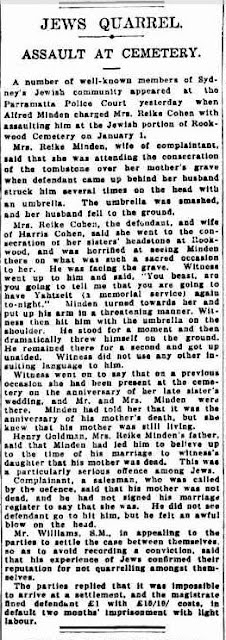

The marriage was clearly difficult. One point of controversy, as exposed in this newspaper article describing a family fight at the cemetery for the dedication of Rieke's mother's stone there, may have been that Alfred lied about his family of origin. Although he said truthfully that part of the family was engaged in banking, his father was actually a business owner, deceased, and his mother Sophie was still living -- which he may have changed into having lost his mother, as he told his story in Australia.

By 1933, Alfred had become a habitual petty criminal (court cases can be found using this link: http://trove.nla.gov.au/newspaper/result?q=%22Alfred+minden%22), and his "mug shots" are the only photos so far that we can be sure are his:


His marriage to Rieke was,  we hope, over by 6 November 1934, when Alfred married again, this time to Veronica Mary Schweida or Sweida. She was one of three sisters, shown in the photo here. The couple soon had a  daughter, Frances Sophie Minden, born 1935, died 1941, with a coroner's inquest that found "Injuries accidentally sustained by being run over by a motor lorry."

In 1939 he was interned for about three weeks, as a German in Australia, despite his official British status. The internment documents show that the police collected him and that he "refused to sign" something, so evidently he resisted being collected.

Arrested in 1940 for burglary with a young woman companion (Sydney Morning Herald, Friday 22 March 1940, thanks to the National Library of Australia), Alfred by then had a reputation for womanizing, and according to the newspaper, two children, although only one -- the child who died -- can be found documented.


However, Alfred must have made some sort of peace with Australia and his second wife, as he entered the armed service there in 1941 and served until 1943, with his wife Veronica listed as his next of kin. One wonders what changes he experienced during this time.

We know only that in 1951 he returned to England, and died there at age 50.

His niece Ruth says that she never met him and never knew he returned to England, but that she remembers knowing that he had been "sent away to Australia" because he was an unmanageable teen who had done something "bad."

Although Alfred's documented life was often dishonorable, Ruth said that Alfred's presence in Australia saved the life of his younger sister Claire and her family, who also emigrated to Australia. Claire married Herbert Goldfeld, and they changed their surname to Gore; they had a son Werner Goldfeld, born about 1931. Claire appears on one of the internment documents as Alfred's next of kin. I think this son's name may have become Sydney Gore. We hope to connect with this part of the family later, and add to this story of how Alfred's "black sheep" status may have had some positive aspects, after all.

Sunday, January 3, 2016

Photos: Hertz Minden and Sophie (Behrens) Minden and Descendants

These photos are provided by Inbal Jaffe, whose father Uri Jaffe is the son of Herbert Jaffe, who is the son of Franziska (Minden) Jaffe. Franziska was the daughter of Iwan Minden, brother of Max Minden (Generation A). The parents of Iwan and Max were Hertz Simon Naftali Minden (1818-1887) and Sophie (Behrens) Minden (1834-1906) (Generation B).

So, here are Hertz (here labeled Henry) and Sophie of Generation B, and their son Iwan, at left.


Inbal also provided these three photos, in which the man with the heavy moustache at lower left is her great-great-grandfather Iwan; we look forward to more identifications:


Also from Inbal's collection is this photo of three of the family's Henrys:


At left is Henry Minden who was living in Hannover, Germany, at the time of the photo; at the center, Dr. (of law) Henry Minden of London (Generation 1); and Henry Minden of New York. (The German word "jetzt" means "now" in English.)

I add here what I know of Henry Minden of New York, on the right. He was a grandfatherly presence in my life when I was a child (1950s, 1960s). My parents said he was a "cousin" of Ernest. Ruth (Minden) Novice said he was adopted by one of the Minden men of Generation A, but she was not sure which; Inbal suggests that it was Siegfried who adopted him. At the time when I knew him, he lived in the town of Great Neck on Long Island, which extends eastward from New York City; his wife, whom he outlived, was Betty Fishman (it was her second marriage; she had a son Alan). Henry of New York married second Lore (of Holland I think). According to a book of history of the Warburg banking enterprises, Henry Minden of New York was instrumental in bringing the Warburg business to America. My parents also told me that Henry and Betty had escaped Europe via Holland. I have been unable to find birth, marriage, or death documents for them so far.

After some work with the family tree, I wonder: Could the Henry/Henri Minden on the left be Iwan's son Henry?

Photos: Max and Sophie Minden and Their 10 Children

Many thanks to Judi (Novice) Roth for providing these wonderful photos! Here are Max Jechiel Minden (1859-1914) and Sophie (Feitler) Minden (1867-1949) (Generation A by our counting here). Max was born in Hamburg, Germany, and Sophie in Oppenheim, Germany; their first child, Henry, was born in 1890, so at a guess, they may have married around 1888.


Sophie gave birth to 11 children, but one, Siegmond, died at age 8 or 9 (1894-1903).
Here are the remaining 10 children:


The boys are (from oldest) Henry, Robert, Ernest, Hans, and Alfred.
The girls are (from oldest) Anna, Frances, Babette, Lizzy, and for the fifth daughter I have two names, without dates of birth: Claire and Sophie -- Judi or Ruth, can you help on this, please?


Sunday, May 17, 2015

Scattered Wide and Far: Generations 1, 2, 3 ...

Ruth and Meir Novice, 2015
Dave and I were honored and very, very glad to meet Ruth (née Minden) and Meir Novice in Brookline (part of greater Boston) last month. I will write more later about the gathering, brought about graciously by Ruth and Meir's daughter Judi Roth (generation 3). Meanwhile, here is a photo of this amazing couple.

One question I had hoped to resolve during this get-together was the reason that the Mindens of Generation 1 scattered so definitively -- not just geographically but also in terms of how the family in the next two generations (including mine) has not stayed very much in contact. Ruth confirmed that the embrace of very different religious paths among generations 1 and 2 contributed significantly to this pattern. We are fortunate to have among us those who have taken their Judaism to heart in many ways; those who found a home within Roman Catholicism, Protestant faiths, and Christian Science; and others who felt most drawn to rational moral living, without a particular religious belief underpinning it.
In our Vermont home.

Now, in a modern culture that allows us to gently connect via social media, e-mail, and of course letters and visits, I am pleased to find the re-connections in some ways easier than they might have been a hundred years ago.

Saturday, March 21, 2015

Dr. Henry Minden, Lawyer (Generation 1)

I am still trying to pull together the experiences of my childhood with the information I'm learning now. Dr. Henry Minden (Generation 1), a lawyer, was a brother of my grandfather Ernest Minden; I see from his great-grandson David Roth's article (see previous post) that he lived for decades in Golders Green, London. I'm adding here a notice from the February 1972 issue of AJR Information, published by the Association of Jewish Refugees in Great Britain. It acknowledges Dr Minden's death in December 1971.

I met Dr Henry Minden and his wife Anna once when I was a child -- a meal was provided for their visit at the home of yet another Henry (Henri) Minden, this one living in Great Neck on Long Island, New York. I'm guessing it was around 1964. I also visited my grandmother Lena's home in England in 1959 and 1967 (after her divorce from Ernest Minden), and I believe that too was in Golders Green. I don't think I met Henry and Anna during those visits; probably the varied styles of Jewish life did not encourage such a visit at that time. But I met Lotte Gore there, I'm sure -- when I figure out how she connects to all this, I'll annotate this mention. UPDATE: Lena's home was at 56, Clifton Gardens, London NW 11.


Onward!

Henry Minden's Chumash

I was delighted today to discover this thoughtful examination of the chumash and siddur of Henry Minden (Generation 1), by his great-grandson David Roth (Generation 4):

http://onthemainline.blogspot.com/2014/08/guest-post-my-great-grandfathers.html

Saturday, March 14, 2015

Warburg Library Article in the New Yorker

I will write at another time with details of the connections of the Mindens and Warburgs before, during, and after the Second World War -- but at this moment want to point out an article in last week's New Yorker magazine on the Warburg Library. The photo here, of Aby Warburg (second from left) with others in Florence, is one that accompanies the article; photo credit goes to the Warburg Institute. Link to the article: http://www.newyorker.com/magazine/2015/03/16/in-the-memory-ward

Sunday, March 8, 2015

Max Minden & Company, Ltd.: Egg Importers, Hull, England

This is what I remember about my grandfather, Ernest, mentioning selling eggs: His friend Kurt Delbanco told me (about the year 2000) that Kurt himself had started his working career selling pig bristles and related products -- pig bristles were valued for artists' brushes, and Kurt followed that path to become an artist himself. Ernest, on the other hand, started out selling eggs; Kurt smiled at the conjunction of the two agricultural products.

I didn't realize until recently that the likely reason for Ernest Minden (Generation 1) selling eggs as a young man was that this was the family business. Ernest's father was Max Minden (Generation A), and Max owned an egg importing company in Hull, England, called Max Minden & Company, Ltd.

This week I was excited to find three images that relate to the company. First, shown above, is a photo of a company truck! I am trying to obtain the original photo.

Second and third, below, are mentions of the company: one from 1917 in an Iowa publication called The Egg Reporter and clearly referring to the risks of the war for egg importing; and the other, dated 1905, from a Canadian government department. This pair suggests that Max Minden & Co. was importing eggs from both Canada and the United States.


Finally, I can't access the images for these, but the Hill History Centre has a number of documents that include mention of Max Minden & Company in the survey of damages from the Second World War. If you are visiting Hull, please do go look! One of them has the following information:

Forms for the notification of war damage under section 10 of the War Damage Act, 1941. War Damage Commission Form C.

Reference No:
C TCY/2/1/2/770
Dates:
12 Dec 1940
Description:
Position of Property Damaged: Alfred Gelder Street, Max Mindens
Type of Property Damaged: Warehouse
Date of Damage: 12 Dec 1940
Cause of Damage: Incendiary Bombs
Format:
Archive Item
Extent:
1 item
Access Conditions:
Access will be granted to any accredited reader
Repository:
Hull University Archives
Collection:
Town Clerk's Records relating to World War II

Thursday, November 20, 2014

Generation A: Max and Sophie (Feitler) Minden and the Hamburg (Germany) Temple

Much of this information is very new to me -- my research was prompted by a fragment in a letter this week from Georg Iggers (Generation 2; his name was originally Georg Gerson Igersheimer), son of Lizzie (Minden) Iggers of Generation 1, and grandson of Max Minden (Gen. A).

Georg and his wife Wilma wrote alternating chapters for a compelling book on their lives, Two Lives in Uncertain Times, published in 2006. (Note: We have two more copies arriving here next week, one of which is already going to Judi Roth; if someone wants/needs the other, let me know. -- BK) On page 25 in the book, Georg writes of his father, from a very observant Orthodox family in Frankfurt, and his mother's father, Max Minden, who "was the son of the cantor of the central Liberal synagogue, the Temple, in Hamburg. I supsect that my grandmother Sophie also came from a Liberal family in Oppenheim. My grandfather Max seems to have been religiously indifferent but was active in Jewish philanthropy. He helped to resettle Russian Jews in the United States and made at least two trips to the United States to see how they were doing. He became a prosperous businessman, with a firm with branches in Hamburg and Hull, England, that imported eggs and other agricultural products from Russia. There is speculation that his sudden death in February 1914 may have been a suicide due to financial difficulties."

Georg also specifies that the Minden family -- Max and Sophie and children -- lived in Hull, England, from 1894 until 1904, and then returned to Hamburg.

Hamburg city hall.


Georg sees the family as having no formal Jewish religious instruction, and goes on to count that "Of the ten of my grandparents' children who grew to adulthood, four married non-Jews and broke all ties to Judaism. Two became Christian Scientists. Others remained loosely Jewish, which the oldest son, Henry, became an observant Orthodox Jew."

I recommend Georg and Wilma's book for the rest of the story of Georg's family line, as his parents (Lizzie and Alfred) emigrated to Richmond, Virginia.

But that is about all of Max and Sophie's story that Georg recounts in those pages.

I will pull together a few other details later that I've gleaned from reading some Warburg histories. Meanwhile, Cousins, what say you -- do you have more to add on Max and Sophie? I'd also like to know -- Sophie's Feitler family of origin came from Frankfurt. There are other Feitlers in our family as well; do any of you know whether they came from that same family?

Last but not least: I was intrigued by the Wikipedia article on the Hamburg Temple (http://en.wikipedia.org/wiki/Hamburg_Temple), where Max's father was a cantor. I note that the Warburg family is mentioned here, too.

Former Temple of Reform Judaism in Hamburg, built 1844.


New Temple Oberstrasse, 1931-1938.

One more note: I hope those of you who know more about all this will feel free to correct any errors or misstatements here! As I mentioned ... I am new to much of this. I'll explain that in another post, at another time.

Saturday, November 15, 2014

Generation 3: Cousins Beth and Judi Meet as Adults

Judi Roth (Gen. 3; granddaughter of Henry Minden Gen. 1, daughter of Ruth Gen. 2) and I, Beth Kanell (born Elizabeth Lancy Minden, Gen. 3; granddaughter of Ernest Minden Gen. 1, daughter of Walter Minden Gen. 2), met near Boston on November 8, 2014, for the first time.

Or so we believed at the time. Since then, Judi's mother Ruth has added a detail neither Judi nor I knew: Ruth and her husband visited my parents in 1964, when they moved from England to the US. And Judi and I must have met -- but maybe we were both too overwhelmed by being in the midst of changes in our lives to pay enough attention to that moment 50 years ago.

It's wonderful to connect in person, and to hear each other's stories and begin to catch up on being each other's family members. And the flood of information that we and the other "second cousins" (Gen. 3) and their parents are already providing is why I decided to start this blog, to organize and share the details. More of that, soon. Meanwhile, here is a very special photo: one of Judi (on the right) and me, November 2014, Dedham, MA, taken by Judi's friend Steve. - BK

Generation 1: The children of Max and Sophie Minden (more details later)

Henry Minden.

Anna Minden.

Siegmund Minden.

Robert Minden.

Frances Minden.

Ernst / Ernest Minden.

Babette Minden.

Alfred Minden.

Lizzie Minden.

Hans Minden.

Claire Minden.

-- BK

Max Minden, 1859-1914

Max Minden is in Generation A. Here's what I have so far for dates for him:

Born 1859, 22 May, Hamburg, Germany.
By 1901, at age 42, he is mentioned as residing in Sculcoates, Yorkshire, England.
I have evidence that in 1906, on 26 January, at age 46, he visited New York, New York.
  • And his death is recorded as taking place in 1914 on 21 February at age 54 in Hamburg.

    See the newer post on his egg company in Hull, England, Max Minden & Company Ltd.

    -- BK